Learn about Ford Explorer (U251; 2006-2010) fuse box and relay’s locations, functions, and maintenance tips for optimal vehicle electrical system.
If your 2006-2010 Ford Explorer is experiencing electrical gremlins—like a dead cigarette lighter, unresponsive power windows, or a malfunctioning dashboard light—the culprit is often a blown fuse or faulty relay. Before heading to a mechanic, knowing where to find your Explorer’s fuse boxes can help you quickly identify and often fix the problem yourself.
Fuses and relays are critical components that protect your vehicle’s electrical system from damage. Fuses act as sacrificial links in a circuit, breaking the connection when too much current flows through to prevent damage to wiring and components. Relays work differently, acting as electrically controlled switches that manage higher-current devices like the horn, fuel pump, and cooling fans using a low-current trigger signal.
For Ford Explorer owners, understanding fuse box and relay locations isn’t just useful for emergency repairs—it’s practical knowledge that helps with routine maintenance and troubleshooting. Whether you’re dealing with a specific electrical fault or just want to be prepared, this guide will walk you through everything you need to know about the fuse box locations on your 2006-2010 Explorer.
MUST READ: DYI – How to Check Car Fuses?
(2006-2010) Ford Explorer U251 fuse box and relay with Diagram
WARNING
- Never replace a fuse with one that has a higher amperage rating.
- A fuse with a too-high amperage could damage the electrical part and cause a fire.
- On no account should fuses be repaired (e.g. patched up with tin foil or wire) as this may cause serious damage elsewhere in the electrical circuit or cause a fire.
- If a fuse blows repeatedly, do not keep replacing it. Instead, have the cause for the repeated short circuit or overload tracked and fixed.
- Terminal and harness assignments for individual connectors will vary depending on vehicle equipment level, model, and market.
Ford Explorer (U251; 2006-2010) fuse assignment
Ford Explorer U251 Year of production: 2006, 2007, 2008, 2009, 2010
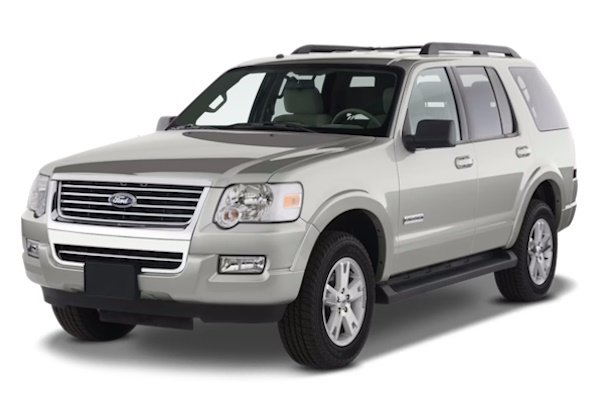
This generation of the Ford Explorer (chassis code U251) features multiple fuse and relay locations designed to manage the vehicle’s increasingly complex electrical systems. You’ll typically find two main fuse boxes, with some models featuring an additional auxiliary junction box depending on trim level and options.
Engine Compartment Fuse Box (Power Distribution Box)
The primary fuse box under the hood is called the Power Distribution Box, located on the driver’s side of the engine bay, near the battery. This box houses high-amperage fuses and relays responsible for critical systems including the engine cooling fan, ABS module, headlights, and air conditioning compressor clutch.
To access this fuse box, ensure the engine is off and the ignition key is removed. Look for a large black plastic cover secured with clips or retaining tabs along its edges. Depending on your specific trim, you may need to press down on release tabs or unscrew a couple of fasteners before lifting the cover off. The fuse and relay diagram is typically printed on the inside of this cover for easy reference once it’s removed.
Interior Fuse Box (Passenger Compartment)
The interior fuse panel is located inside the cabin, on the driver’s side, tucked beneath the dashboard near the left kick panel area. This fuse box controls interior electrical systems such as the radio, power seats, interior lighting, power door locks, and instrument cluster.
To access it, sit in the driver’s seat and locate the panel cover near your left knee, below the steering wheel. The cover is usually held in place by a simple latch or a couple of screws. Once removed, you’ll see the fuse layout, along with a diagram often printed on the cover’s interior surface to help you identify each fuse’s function.
Rear Auxiliary Junction Box (If Equipped)
Depending on your Explorer’s trim level and factory-installed options, there may be an additional fuse or relay panel located in the rear cargo area, often near the trunk lining or behind a side panel. This auxiliary box typically manages accessories like the rear power outlet, third-row seating electronics, or trailer tow package relays.
If your Explorer includes this feature, you’ll usually find it by lifting the cargo area carpet or opening a small access panel on the side wall of the trunk. Check your specific trim’s documentation, as not all 2006-2010 Explorers include this additional junction box.
How to Safely Access and Work with Fuses and Relays
Safety should always come first when working with your vehicle’s electrical system. Before opening any fuse box, turn off the ignition and remove the key. If you plan on replacing multiple fuses or working near the battery terminals, disconnecting the negative battery cable is a smart precaution to avoid short circuits or accidental shocks.
When pulling a fuse, use the plastic fuse puller tool, which is often clipped inside the engine bay fuse box cover or interior panel. This tool grips the fuse securely without risking damage to the terminals. Avoid using metal tools like screwdrivers or pliers, as they can cause sparks or short circuits if they accidentally touch multiple terminals at once.
Relays require a slightly different approach since they’re plugged into sockets rather than snapped into place like fuses. Gently wiggle the relay side to side while pulling upward to release it without bending the connector pins. If it feels stuck, check for a small retaining clip or bracket before pulling harder.
Identifying the Right Fuse or Relay
Each fuse and relay in your Ford Explorer’s fuse boxes is labeled with a number or letter that corresponds to a printed diagram, usually located on the inside of the fuse box cover or in your owner’s manual. This diagram tells you exactly which fuse controls which component, from your power mirrors to your instrument panel lighting.
Before removing any fuse, cross-reference the diagram with the physical fuse box to confirm you’re pulling the correct one. This saves time and prevents you from accidentally disturbing unrelated circuits while troubleshooting.
A blown fuse is usually easy to spot—look for a discolored appearance or a visibly broken metal strip inside the clear plastic housing. Always replace a blown fuse with one of the same amperage rating. Installing a higher-rated fuse can lead to wiring damage or even create a fire risk, so it’s important to match the replacement exactly.
Checking and Replacing Fuses in Ford Explorer
If electrical components in the vehicle are not working, a fuse may have blown. Blown fuses are identified by a broken wire within the fuse. Check the appropriate fuses before replacing any electrical components. To remove a fuse use the fuse puller tool provided on the fuse panel box.
Location of Fuse Boxes
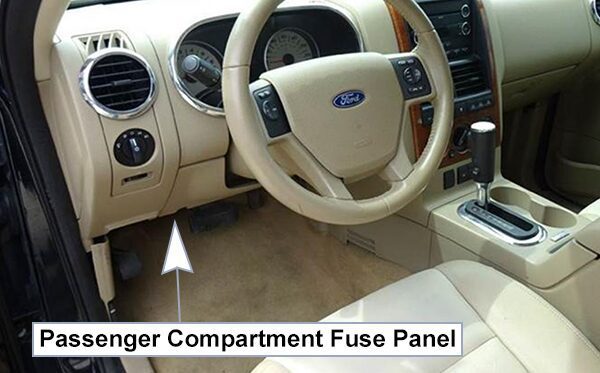
Passenger Compartment Fuse Panel:
The fuse panel is located below the instrument panel on the driver’s side.
Relays:
The following relays are located on either side of the passenger compartment fuse panel. See your authorized dealer for service of these relays.
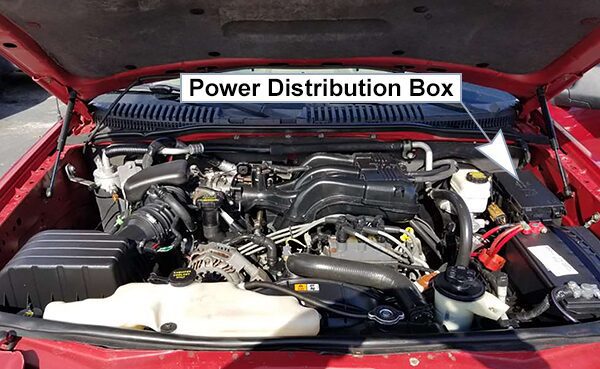
Power Distribution Box:
The power distribution box is located in the engine compartment. The power distribution box contains high-current fuses that protect your vehicle’s main electrical systems from overloads.
Fuse Box Diagrams
2006
Passenger Compartment Fuse Panel
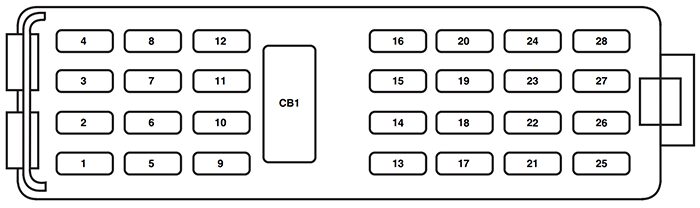
List of fuses in the passenger compartment fuse panel (2006)
| № | A | Description |
|---|---|---|
| 1 | 20A | Moonroof, Adjustable pedais, DSM, Memory lumbar motor |
| 2 | 5A | Microcontroller power (SJB) |
| 3 | 20A | Radio |
| 4 | 20A | OBD II connector |
| 5 | 5A | Moonroof |
| 6 | 20A | Liftglass release motor, Door unlock/lock |
| 7 | 15A | Trailer stop/turn |
| 8 | 15A | Ignition switch power, PATS |
| 9 | 2A | 6R TCM/PCM (Ignition RUN/START), Fuel pump relay |
| 10 | 5A | Front wiper RUN/ACC relay in PDB |
| 11 | 5A | Radio start |
| 12 | 5A | Rear wiper motor RUN/ACC, Trailer battery charge relay in PDB, Radio |
| 13 | 15A | Heated mirror, Rear defrost indicator |
| 14 | 20A | Horn |
| 15 | 10A | Reverse lamps |
| 16 | 10A | Trailer reverse lamps |
| 17 | 10A | RCM, PAD lamp, OCS module |
| 18 | 10A | Reverse park aid, IVD switch, IVD, 4×4 module, 4×4 switch, Heated seat switches, Compass, Electrochromatic mirror, AUX climate control |
| 19 | – | Not used |
| 20 | 10A | Manual climate, DEATC, Brake shift |
| 21 | – | Not used |
| 22 | 15A | Brake switch, Bi-color stop lamps, CHMSL all turn |
| 23 | 15A | Power mirrors, Interior lamps, Puddle lamps, Battery saver, Instrument illumination, Homelink |
| 24 | 10A | Cluster, Theft LED |
| 25 | 15A | Trailer park, Trailer electronic brake module |
| 26 | 15A | License plate/rear park lamp, Front park lamps, Manual climate |
| 27 | 15A | Tri-color stop lamps |
| 28 | 10A | Manual/DEATC |
| CB1 | 25A | Windows |
| Relays | ||
| Relay 1 | Delayed ACC | |
| Relay 2 | Rear defrost | |
| Relay 3 | Park lamps | |
| Relay 4 | RUN/START | |
Power Distribution Box
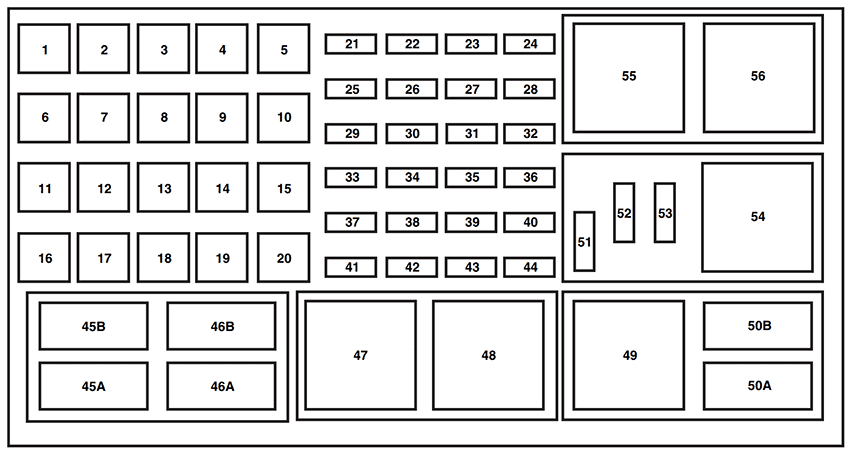
List of fuses in the power distribution box (2006)
| № | A | Description |
|---|---|---|
| 1 | 50A** | BATT 2 (SJB) |
| 2 | 50A** | BATT 3 (SJB) |
| 3 | 50A** | BATT 1 (SJB) |
| 4 | 30A** | Fuel pump, Injectors |
| 5 | 30A** | Third row seat (left) |
| 6 | 40A** | IVD module |
| 7 | 40A** | Powertrain Control Module (PCM) |
| 8 | – | Not used |
| 9 | – | Not used |
| 10 | 30A** | Power seat (right) |
| 11 | 30A** | Starter |
| 12 | 30A** | Third row seat (right) |
| 13 | 30A** | Trailer tow battery charger |
| 14 | 30A** | Memory seats (DSM) |
| 40A** | Non-memory seats | |
| 15 | 40A** | Rear defrost, Heated mirrors |
| 16 | 40A** | Blower motor |
| 17 | 30A** | Trailer electronic brakes |
| 18 | 30A** | Auxiliary blower motor |
| 19 | – | Not used |
| 20 | – | Not used |
| 21 | 20A* | Rear power point |
| 22 | 20A* | Subwoofer |
| 23 | 20A* | 4×4 |
| 24 | 10A* | Powertrain Control Module (PCM) KAP, CAN vent |
| 25 | 20A* | Front power point/Cigar lighter |
| 26 | 20A* | 4×4 module |
| 27 | 20A* | 6R Transmission module |
| 28 | 20A* | Heated seats |
| 29 | 20A* | Headlamps (right) |
| 30 | 25A* | Rear wiper |
| 31 | 15A* | Fog lamps |
| 32 | – | Not used |
| 33 | 30A* | IVD module |
| 34 | 20A* | Headlamps (left) |
| 35 | 10A* | AC clutch |
| 36 | – | Not used |
| 37 | 30A* | Front wiper |
| 38 | 15A* | 5R Transmission |
| 39 | 15A* | PCM power |
| 40 | 15A* | Fan clutch, PCV valve, AC clutch relay, GCC fan |
| 41 | 15A* | SDARS/DVD |
| 42 | 15A* | Redundant brake switch, EVMV, MAFS, HEGO, EVR, VCT1, VCT2, CMCV, CMS |
| 43 | 15A* | Coil on plug (4.6L engine only), Coil tower (4.0L engine only) |
| 44 | 15A* | Injectors |
| 45A | – | Not used |
| 45B | – | GCC fan relay |
| 46A | – | Not used |
| 46B | – | Not used |
| 47 | – | Front wiper relay |
| 48 | – | PCM relay |
| 49 | – | Fuel pump relay |
| 50A | – | Fog lamps relay |
| 50B | – | AC clutch relay |
| 51 | – | Not used |
| 52 | – | A/C clutch (diode) |
| 53 | – | Not used |
| 54 | – | Trailer battery charger relay |
| 55 | – | Starter relay |
| 56 | – | Blower relay |
| * Mini Fuses ** Cartridge Fuses | ||
2007
Passenger Compartment Fuse Panel
List of fuses in the passenger compartment fuse panel (2007)
| № | A | Description |
|---|---|---|
| 1 | 20A | Moonroof, Adjustable pedais, DSM, Memory lumbar motor |
| 2 | 5A | Microcontroller power (SJB) |
| 3 | 20A | Radio |
| 4 | 10A | OBD II connector |
| 5 | 5A | Moonroof |
| 6 | 20A | Liftglass release motor, Door unlock/lock |
| 7 | 15A | Trailer stop/turn |
| 8 | 15A | Ignition switch power, PATS |
| 9 | 2A | 6R TCM/PCM (Ignition RUN/START), Fuel pump relay |
| 10 | 5A | Front wiper RUN/ACC relay in PDB |
| 11 | 5A | Radio start |
| 12 | 5A | Rear wiper motor RUN/ACC, Trailer battery charge relay in PDB, Radio |
| 13 | 15A | Heated mirror, Manual climate rear defrost indicator |
| 14 | 20A | Horn |
| 15 | 10A | Reverse lamps |
| 16 | 10A | Trailer reverse lamps |
| 17 | 10A | RCM, PAD lamp, OCS module |
| 18 | 10A | Reverse park aid, IVD switch, IVD, 4×4 module, 4×4 switch, Heated seat switches, Compass, Electrochromatic mirror, AUX climate control |
| 19 | – | Not used |
| 20 | 10A | Manual climate, DEATC, Brake shift |
| 21 | – | Not used |
| 22 | 15A | Brake switch, Bi-color stop lamps, CHMSL, All turn lamps |
| 23 | 15A | Interior lamps, Puddle lamps, Battery saver, Instrument illumination, Homelink |
| 24 | 10A | Cluster, Theft LED |
| 25 | 15A | Trailer tow park lamps |
| 26 | 15A | License plate/rear park lamp, Front park lamps, Manual climate |
| 27 | 15A | Tri-color stop lamps |
| 28 | 10A | Manual/DEATC |
| CB1 | 25A | Windows |
| Relays | ||
| Relay 1 | Delayed ACC | |
| Relay 2 | Rear defrost, Heated mirrors | |
| Relay 3 | Park lamps | |
| Relay 4 | RUN/START | |
Power Distribution Box
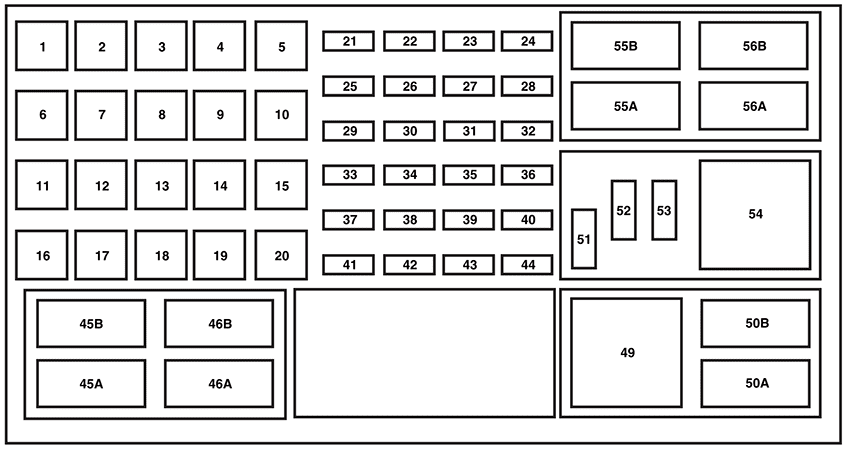
List of fuses in the power distribution box (2007)
| № | A | Description |
|---|---|---|
| 1 | 50A** | BATT 2 (SJB) |
| 2 | 50A** | BATT 3 (SJB) |
| 3 | 50A** | BATT 1 (SJB) |
| 4 | 30A** | Fuel pump, Injectors |
| 5 | 30A** | Third row seat (left) |
| 6 | 40A** | ABS pump |
| 7 | 40A** | Powertrain Control Module (PCM) |
| 8 | 40A** | Heated windshield (left) |
| 9 | 40A** | Heated windshield (right) |
| 10 | 30A** | Power seat (right) |
| 11 | 30A** | Starter |
| 12 | 30A** | Third row seat (right) |
| 13 | 30A** | Trailer tow battery charger |
| 14 | 30A** | Memory seats (DSM) |
| 40A** | Non-memory seats | |
| 15 | 40A** | Rear defrost, Heated mirrors |
| 16 | 40A** | Blower motor |
| 17 | 30A** | Trailer electronic brakes |
| 18 | 30A** | Auxiliary blower motor |
| 19 | 30A** | Running boards |
| 20 | – | Not used |
| 21 | 20A* | Rear power point |
| 22 | 20A* | Subwoofer |
| 23 | 20A* | 4×4 |
| 24 | 10A* | Powertrain Control Module (PCM) KAP, CAN vent |
| 25 | 20A* | Front power point/Cigar lighter |
| 26 | 20A* | 4×4 module |
| 27 | 20A* | 6R Transmission module |
| 28 | 20A* | Heated seats, Power mirrors |
| 29 | 15A* | Headlamps (right) |
| 30 | 25A* | Rear wiper |
| 31 | 15A* | Fog lamps |
| 32 | 5A* | Power mirrors |
| 33 | 30A* | ABS valve |
| 34 | 15A* | Headlamps (left) |
| 35 | 10A* | AC clutch |
| 36 | – | Not used |
| 37 | 30A* | Front wiper |
| 38 | 15A* | 5R Transmission |
| 39 | 15A* | PCM power |
| 40 | 15A* | Fan clutch, PCV valve,AC clutch relay, GCC fan |
| 41 | 15A* | SDARS/DVD |
| 42 | 15A* | Redundant brake switch, EVMV, MAFS, HEGO, EVR, VCT1, VCT2, CMCV, CMS |
| 43 | 15A* | Coil on plug (4.6L engine only), Coil tower (4.0L engine only) |
| 44 | 15A* | Injectors |
| 45B | – | GCC fan relay |
| 45A | – | Not used |
| 46B | – | Not used |
| 46A | – | Not used |
| 49 | – | Fuel pump relay |
| 50B | – | A/C clutch relay |
| 50A | – | Fog lamps relay |
| 51 | – | Not used |
| 52 | – | A/C clutch (diode) |
| 53 | – | Not used |
| 54 | – | Trailer battery charger relay |
| 55B | – | Front wiper relay |
| 55A | – | PCM relay |
| 56B | – | Starter relay |
| 56A | – | Blower relay |
| * Mini Fuses ** Cartridge Fuses | ||
2008
Passenger Compartment Fuse Panel
List of fuses in the passenger compartment fuse panel (2008)
| № | A | Description |
|---|---|---|
| 1 | 20A | Moonroof, Adjustable pedais, Memory seats, Memory lumbar motor |
| 2 | 5A | Microcontroller power (SJB) |
| 3 | 20A | Radio |
| 4 | 10A | OBD II connector |
| 5 | 5A | Moonroof, Door lock switch illumination, Rearview mirror with microphone |
| 6 | 20A | Liftglass release motor, Door unlock/lock |
| 7 | 15A | Trailer stop/turn |
| 8 | 15A | Ignition switch power, PATS, Cluster |
| 9 | 2A | 6R TCM/PCM (Ignition RUN/START), Fuel pump relay |
| 10 | 5A | Front wiper RUN/ACC relay in PDB |
| 11 | 5A | Radio start |
| 12 | 5A | Rear wiper motor RUN/ACC, Trailer battery charge relay in PDB, Radio |
| 13 | 15A | Heated mirror, Manual climate rear defrost indicator |
| 14 | 20A | Horn |
| 15 | 10A | Reverse lamps |
| 16 | 10A | Trailer reverse lamps |
| 17 | 10A | RCM (restraints), Passenger occupancy |
| 18 | 10A | Reverse park aid, IVD switch, IVD, 4×4 module, 4×4 switch, Heated seat switches, Compass, Electrochromatic mirror, AUX climate control |
| 19 | – | Not used |
| 20 | 10A | Manual climate, DEATC, Brake shift |
| 21 | – | Not used |
| 22 | 15A | Brake switch, Bi-color stop lamps, CHMSL, All turn lamps |
| 23 | 15A | Interior lamps, Puddle lamps, Battery saver, Instrument illumination, Homelink |
| 24 | 10A | Cluster, Theft LED |
| 25 | 15A | Trailer tow park lamps |
| 26 | 15A | License plate/rear park lamp, Front park lamps, Manual climate |
| 27 | 15A | Tri-color stop lamps |
| 28 | 10A | Manual/DEATC |
| CB1 | 25A | Windows |
| Relays | ||
| Relay 1 | Delayed ACC | |
Power Distribution Box
List of fuses in the power distribution box (2008)
| № | A | Description |
|---|---|---|
| 1 | 50A** | BATT 2 (SJB) |
| 2 | 50A** | BATT 3 (SJB) |
| 3 | 50A** | BATT 1 (SJB) |
| 4 | 30A** | Fuel pump, Injectors |
| 5 | 30A** | Third row seat (left) |
| 6 | 40A** | ABS pump |
| 7 | 40A** | Powertrain Control Module (PCM) |
| 8 | 40A** | Heated windshield (left) |
| 9 | 40A** | Heated windshield (right) |
| 10 | 30A** | Power seat (right) |
| 11 | 30A** | Starter |
| 12 | 30A** | Third row seat (right) |
| 13 | 30A** | Trailer tow battery charger |
| 14 | 30A** | Memory seats (DSM) |
| 40A** | Non-memory seats | |
| 15 | 40A** | Rear defrost, Heated mirrors |
| 16 | 40A** | Front blower motor |
| 17 | 30A** | Trailer electronic brakes |
| 18 | 30A** | Auxiliary blower motor |
| 19 | 30A** | Running boards |
| 20 | 30A** | Front wiper motor |
| 21 | 20A* | Rear power point |
| 22 | 20A* | Subwoofer |
| 23 | 20A* | 4×4 |
| 24 | 10A* | Powertrain Control Module (PCM) Keep Alive Power, Canister vent |
| 25 | 20A* | Front power point/Cigar lighter |
| 26 | 20A* | 4×4 module |
| 27 | 20A* | 6R Transmission module (4.6L engine only) |
| 28 | 20A* | Heated seats |
| 29 | 15A* | Headlamps (right) |
| 30 | 25A* | Rear wiper |
| 31 | 15A* | Fog lamps |
| 32 | 5A* | Power mirrors |
| 33 | 30A* | ABS valve |
| 34 | 15A* | Headlamps (left) |
| 35 | 10A* | AC clutch |
| 36 | 20A* | Console bin power point |
| 37 | 30A* | Driver window motor |
| 38 | 15A* | 5R Transmission (4.0L engine only) |
| 39 | 15A* | PCM power |
| 40 | 15A* | Fan clutch, PCV valve (4.0L engine only), AC clutch relay, GCC fan |
| 41 | 15A* | SDARS, DVD, SYNC |
| 42 | 15A* | Redundant brake switch, EVMV, MAFS, HEGO, EVR, VCT1 (4.6L engine only), VCT2 (4.6L engine only), CMCV (4.6L engine only), CMS |
| 43 | 15A* | Coil on plug (4.6L engine only), Coil tower (4.0L engine only) |
| 44 | 15A* | Injectors |
| 45B | – | GCC fan relay |
| 45A | – | Not used |
| 46B | – | Not used |
| 46A | – | Not used |
| 49 | – | Fuel pump relay |
| 50B | – | A/C clutch relay |
| 50A | – | Fog lamps relay |
| 51 | – | Not used |
| 52 | – | Not used |
| 53 | – | One Touch Integrated Start (OTIS) (diode) |
| 54 | – | Trailer battery charger relay |
| 55B | – | Front wiper relay |
| 55A | – | PCM relay |
| 56B | – | Starter relay |
| 56A | – | Blower relay |
| * Mini Fuses ** Cartridge Fuses | ||
2009
Passenger Compartment Fuse Panel
List of fuses in the passenger compartment fuse panel (2009)
| № | A | Protected Circuits |
|---|---|---|
| 1 | 20A | Moon roof, Adjustable pedais, Memory seats, Memory lumbar motor |
| 2 | 5A | Microcontroller power (SJB) |
| 3 | 20A | Radio, Navigation amplifier |
| 4 | 10A | OBD II connector |
| 5 | 5A | Moon roof, Door lock switch illumination, Rearview mirror with microphone |
| 6 | 20A | Liftglass release motor, Door unlock/lock |
| 7 | 15A | Trailer stop/turn |
| 8 | 15A | Ignition switch power, PATS, Cluster |
| 9 | 2A | 6R TCM/PCM (Ignition RUN/START), Fuel pump relay |
| 10 | 5A | Front wiper RUN/ACC relay in PDB |
| 11 | 5A | Radio start |
| 12 | 5A | Rear wiper motor RUN/ACC, Trailer battery charge relay in PDB, Radio |
| 13 | 15A | Heated mirror, Manual climate rear defrost indicator |
| 14 | 20A | Horn |
| 15 | 10A | Reverse lamps |
| 16 | 10A | Trailer reverse lamps |
| 17 | 10A | RCM (restraints), Passenger occupancy |
| 18 | 10A | Reverse park aid, IVD switch, IVD, 4×4 module, 4×4 switch, Heated seat switches, Compass, Electrochromatic mirror, AUX climate control |
| 19 | – | Not used |
| 20 | 10A | Manual climate, DEATC, Brake shift |
| 21 | – | Not used |
| 22 | 15A | Brake switch, Bi-color stop lamps, CHMSL, All turn lamps |
| 23 | 15A | Interior lamps, Puddle lamps, Battery saver, Instmment illumination, Homelink |
| 24 | 10A | Cluster, Theft LED |
| 25 | 15A | Trailer tow park lamps |
| 26 | 15A | License plate/rear park lamp, Front park lamps, Manual climate |
| 27 | 15A | Tri-color stop lamps |
| 28 | 10A | Manual/DEATC |
| CB1 | 25A | Windows |
| Relays | ||
| Relay 1 | Delayed accessory relay | |
Power Distribution Box
List of fuses in the power distribution box (2009)
| № | A | Protected Circuits |
|---|---|---|
| 1 | 50A** | BATT 2 (SJB) |
| 2 | 50A** | BATT 3 (SJB) |
| 3 | 50A** | BATT 1 (SJB) |
| 4 | 30A** | Fuel pump, Injectors |
| 5 | 30A** | Third row seat (left) |
| 6 | 40A** | ABS pump |
| 7 | 40A** | Powertrain Control Module (PCM) |
| 8 | – | Not used |
| 9 | – | Not used |
| 10 | 30A** | Power seat (right) |
| 11 | 30A** | Starter |
| 12 | 30A** | Third row seat (right) |
| 13 | 30A** | Trailer tow battery charger |
| 14 | 30A** | Memory seats (DSM) |
| 40A** | Non-memory seats | |
| 15 | 40A** | Rear defrost, Heated mirrors |
| 16 | 40A** | Front blower motor |
| 17 | 30A** | Trailer electronic brakes |
| 18 | 30A** | Auxiliary blower motor |
| 19 | 30A** | Running boards |
| 20 | 30A** | Front wiper motor |
| 21 | 20A* | Rear power point |
| 22 | 20A* | Subwoofer |
| 23 | 20A* | 4×4 |
| 24 | 10A* | Powertrain Control Module (PCM) Keep Alive Power, Canister vent |
| 25 | 20A* | Front power point/Cigar lighter |
| 26 | 20A* | 4×4 module (4.6L engine only) |
| 27 | 20A* | 6R Transmission module (4.6L engine only) |
| 28 | 20A* | Heated seats |
| 29 | 15A* | Headlamps (right) |
| 30 | 25A* | Rear wiper |
| 31 | 15A* | Fog lamps |
| 32 | 5A* | Power mirrors |
| 33 | 30A* | ABS valve |
| 34 | 15A* | Headlamps (left) |
| 35 | 10A* | AC clutch |
| 36 | 20A* | Console bin power point |
| 37 | 30A* | Driver window motor |
| 38 | 15A* | 5R Transmission (4.0L engine only) |
| 39 | 15A* | PCM power |
| 40 | 15A* | Fan clutch, PCV valve, AC clutch relay, GCC fan |
| 41 | 15A* | SDARS, DVD, SYNC |
| 42 | 15A* | Redundant brake switch, EVMV, MAFS, HEGO, EVR, VCT1 (4.6L engine only), VCT2 (4.6L engine only), CMCV (4.6L engine only), CMS |
| 43 | 15A* | Coil on plug (4.6L engine only), Coil tower (4.0L engine only) |
| 44 | 15A* | Injectors |
| 45B | – | GCC fan relay |
| 45A | – | Not used |
| 46B | – | Not used |
| 46A | – | Not used |
| 49 | – | Fuel pump relay |
| 50B | – | A/C clutch relay |
| 50A | – | Fog lamps relay |
| 51 | – | Not used |
| 52 | – | Not used |
| 53 | – | One Touch Integrated Start (OTIS) (diode) |
| 54 | – | Trailer battery charger relay |
| 55B | – | Front wiper relay |
| 55A | – | PCM relay |
| 56B | – | Starter relay |
| 56A | – | Blower relay |
| * Mini Fuses ** Cartridge Fuses | ||
2010
Passenger Compartment Fuse Panel
List of fuses in the passenger compartment fuse panel (2010)
| № | A | Protected Circuits |
|---|---|---|
| 1 | 20A | Moon roof, Adjustable pedais, Memory seats, Lumbar motor |
| 2 | 5A | Microcontroller power |
| 3 | 20A | Radio, Navigation amplifier, GPS module |
| 4 | 10A | On-board diagnostic (OBD II) connector |
| 5 | 5A | Moon roof, Door lock switch illumination, Auto dimming rear view mirror |
| 6 | 20A | Liftglass release motor, Door unlock/lock |
| 7 | 15A | Trailer stop/turn |
| 8 | 15A | Ignition switch power, Passive anti-theft system (PATS), Cluster |
| 9 | 2A | 6R Transmission control module/Powertrain control module (Ignition RUN/START), Fuel pump relay |
| 10 | 5A | Front wiper RUN/ACC relay in power distribution box (PDB) |
| 11 | 5A | Radio start |
| 12 | 5A | Rear wiper motor RUN/ACC, Trailer battery charge relay in PDB, Radio |
| 13 | 15A | Heated mirror, Manual climate rear defrost indicator |
| 14 | 20A | Horn |
| 15 | 10A | Reverse lamps |
| 16 | 10A | Trailer reverse lamps |
| 17 | 10A | Restraints control module, Passenger occupancy |
| 18 | 10A | Reverse park aid, Roll Stability Control (RSC) switch, RSC, 4×4 module, 4×4 switch, Heated seat switches, Auxiliary climate control |
| 19 | – | Not used |
| 20 | 10A | Climate control system, Brake shift |
| 21 | – | Not used |
| 22 | 15A | Brake switch, Bi-color stop lamps, High-mount brake lamp, All turn lamps |
| 23 | 15A | Interior lamps, Puddle lamps, Battery saver, Instrument illumination, HomeLink |
| 24 | 10A | Cluster, Theft indicator light |
| 25 | 15A | Trailer tow park lamps |
| 26 | 15A | License plate/rear park lamp, Front park lamps, Manual climate |
| 27 | 15A | Tri-color stop lamps |
| 28 | 10A | Climate Controls |
| CB1 | 25A | Windows |
| Relays | ||
| Relay 1 | Delayed accessory relay | |
Power Distribution Box
List of fuses in the power distribution box (2010)
| № | A | Protected Circuits |
|---|---|---|
| 1 | 50A** | Battery feed 2 (passenger compartment fuse panel) |
| 2 | 50A** | Battery feed 3 (passenger compartment fuse panel) |
| 3 | 50A** | Battery feed 1 (passenger compartment fuse panel) |
| 4 | 30A** | Fuel pump, Injectors |
| 5 | 30A** | Third row seat (left) |
| 6 | 40A** | Anti-lock brake system (ABS) pump |
| 7 | 40A** | Powertrain control module (PCM) |
| 8 | – | Not used |
| 9 | – | Not used |
| 10 | 30A** | Power seat (right) |
| 11 | 30A** | Starter |
| 12 | 30A** | Third row seat (right) |
| 13 | 30A** | Trailer tow battery charger |
| 14 | 30A** | Memory seats |
| 40A** | Non-memory seats | |
| 15 | 40A** | Rear defrost, Heated mirrors |
| 16 | 40A** | Front blower motor |
| 17 | 30A** | Trailer electronic brakes |
| 18 | 30A** | Auxiliary blower motor |
| 19 | 30A** | Running boards |
| 20 | 30A** | Front wiper motor |
| 21 | 20A* | Rear power point |
| 22 | 20A* | Subwoofer |
| 23 | 20A* | 4×4 |
| 24 | 10A* | PCM – keep alive power, Canister vent |
| 25 | 20A* | Front power point/Cigar lighter |
| 26 | 20A* | 4×4 module (4.6L engine only) |
| 27 | 20A* | 6R Transmission module (4.6L engine only) |
| 28 | 20A* | Heated seats |
| 29 | 15A* | Headlamps (right) |
| 30 | 2 5A* | Rear wiper |
| 31 | 15A* | Fog lamps |
| 32 | 5A* | Power mirrors |
| 33 | 30A* | ABS valve |
| 34 | 15A* | Headlamps (left) |
| 35 | 10A* | A/G clutch |
| 36 | 20A* | Console bin power point |
| 37 | 30A* | Driver window motor |
| 38 | 15A* | 5R Transmission (4.0L engine only) |
| 39 | 15A* | PCM power |
| 40 | 15A* | Fan clutch, Positive crackcase ventilation (PCV) valve, A/C clutch relay |
| 41 | 15A* | Satellite radio module, DVD, SYNC |
| 42 | 15A* | Redundant brake switch, Electronic vapor management valve, Mass air flow sensor, Heated exhaust gas oxygen (HEGO) sensor, EVR, Variable cam timing (VCT)l (4.6L engine only), VCT2 (4.6L engine only), CMCV (4.6L engine only), Catalyst monitor sensor |
| 43 | 15A* | Coil on plug (4.6L engine only), Coil tower (4.0L engine only) |
| 44 | 15A* | Injectors |
| 45B | – | Not used |
| 45A | – | Not used |
| 46B | – | Not used |
| 46A | – | Not used |
| 49 | – | Fuel pump relay |
| 50B | – | A/C clutch relay |
| 50A | – | Fog lamps relay |
| 51 | – | Not used |
| 52 | – | Not used |
| 53 | – | One touch integrated start (OTIS) (diode) |
| 54 | – | Trailer battery charger relay |
| 55B | – | Front wiper relay |
| 55A | – | PCM relay |
| 56B | – | Starter relay |
| 56A | – | Blower relay |
| * Mini Fuses ** Cartridge Fuses | ||
Conclusion
Understanding the fuse box and relay locations in your 2006-2010 Ford Explorer gives you the confidence to troubleshoot common electrical issues without immediately reaching for the phone to call a mechanic. From the engine bay’s Power Distribution Box to the interior panel near the driver’s kick panel, knowing where these components live makes diagnosing problems faster and easier.
However, if you’ve checked and replaced the relevant fuses or relays and the issue persists, it’s worth consulting a qualified mechanic. Persistent electrical problems can sometimes indicate deeper wiring issues or component failures that require specialized diagnostic equipment to resolve properly. When in doubt, professional help ensures your Explorer’s electrical system stays safe and reliable.